The 2026 Gaming Revolution: Console Releases & Entertainment’s Future

Latest developments on The 2026 Gaming Revolution: What the Latest Console Releases Mean for the Future of Entertainment., with key facts, verified sources and what readers need to monitor next in Estados Unidos, presented clearly in Inglês (Estados Unidos) (en-US).
The 2026 Gaming Revolution: What the Latest Console Releases Mean for the Future of Entertainment. is shaping today’s agenda with new details released by officials and industry sources. This update prioritizes what changed, why it matters and what to watch next, in a straightforward news format.
The landscape of interactive entertainment is on the cusp of an unprecedented transformation. As 2026 approaches, the convergence of advanced hardware, innovative software, and evolving player expectations signals a profound shift, offering both challenges and unparalleled opportunities for the industry.
This article delves into the core elements driving this revolution, examining how new console releases are not merely incremental upgrades but foundational pillars for a new era of gaming and broader digital entertainment. From technological breakthroughs to shifts in content delivery and consumption, the implications are far-reaching.
Understanding these dynamics is crucial for anyone invested in the future of gaming, from developers and publishers to casual players and technology enthusiasts. The decisions made and technologies introduced in the coming years will define the interactive experiences of the next decade, setting new benchmarks for immersion and engagement.
Unveiling the Next-Generation Console Hardware
The core of the 2026 Gaming Revolution lies in the technological leaps embedded within the upcoming console hardware. These machines are designed to push boundaries far beyond current capabilities, promising a new standard for graphical fidelity, processing power, and overall system efficiency.
Manufacturers are focusing on custom-built components, including advanced GPUs and CPUs, alongside revolutionary storage solutions. These innovations aim to eliminate loading times, enhance open-world environments, and support incredibly complex simulations, fundamentally altering game design paradigms.
Expectations are high for ray tracing capabilities reaching new levels of realism, coupled with sophisticated AI upscaling technologies that will deliver stunning visuals without compromising performance. This hardware foundation is critical for realizing the ambitious visions of game developers worldwide.
Processing Power and Graphical Fidelity
The horsepower under the hood of these new consoles is expected to be staggering, with processing units specifically optimized for gaming workloads. This dedicated architecture will enable developers to create worlds of unprecedented scale and detail, blurring the lines between virtual and reality.
Graphical fidelity stands to benefit immensely from these advancements, moving beyond simple resolution increases to deliver truly photorealistic environments and character models. Dynamic lighting, advanced particle effects, and intricate environmental interactions will become the norm, enhancing player immersion.
Revolutionary Storage Solutions
Solid-State Drives (SSDs) have already demonstrated their transformative impact on current-generation consoles, virtually eliminating loading screens. The 2026 models are anticipated to feature even faster, more integrated storage solutions.
These ultra-high-speed SSDs will not only accelerate game loading but also enable new forms of game design that rely on rapid asset streaming and seamless transitions between vast game areas. This technological shift will contribute significantly to a more fluid and uninterrupted gameplay experience.
- Custom Silicon Architectures: Tailored chips designed for gaming, optimizing performance and efficiency.
- Advanced Ray Tracing: Next-level realistic lighting, shadows, and reflections, enhancing visual depth.
- AI-Powered Upscaling: Technologies like machine learning to render games at lower resolutions and upscale them to higher fidelity with minimal visual loss.
- Ultra-Fast SSDs: Virtually instant loading times and seamless asset streaming for expansive game worlds.
The Evolution of Gaming Experiences: Beyond Traditional Play
The 2026 Gaming Revolution is not just about raw power; it’s about how that power translates into profoundly new types of gaming experiences. Developers are leveraging these advancements to explore innovative gameplay mechanics, narrative structures, and modes of interaction that go far beyond traditional console gaming.
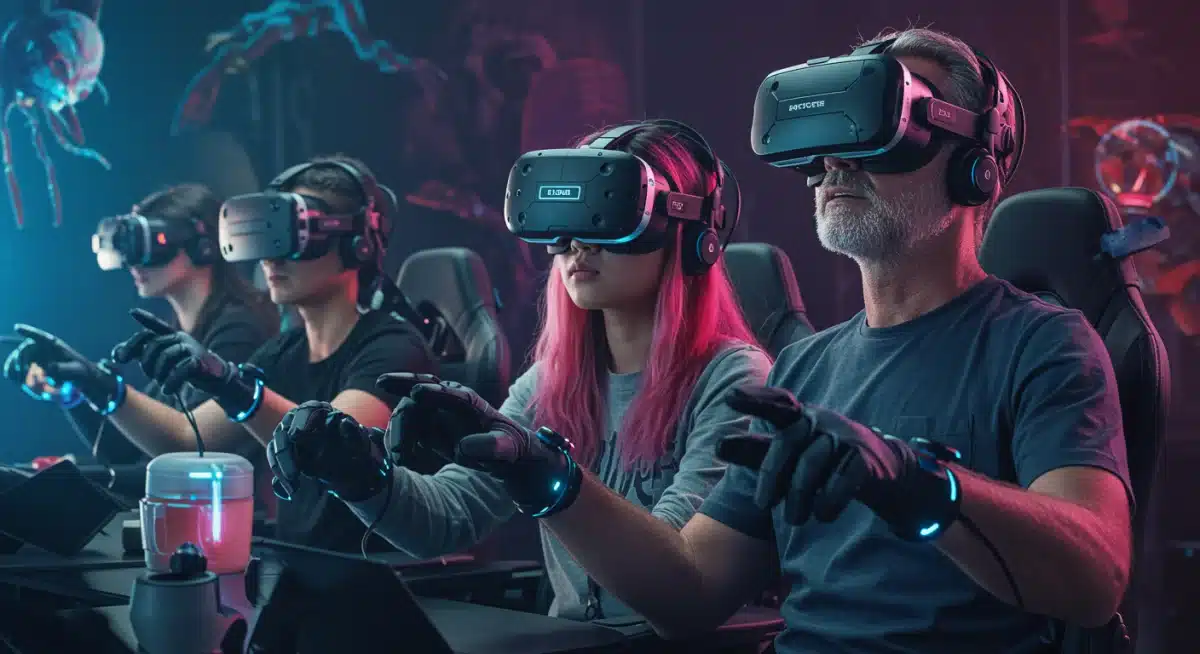
Immersive technologies, particularly virtual reality (VR) and augmented reality (AR), are poised for significant integration, offering deeper levels of engagement. These consoles are being designed with future-proof capabilities to support increasingly sophisticated VR/AR ecosystems, making these experiences more accessible and compelling.
Furthermore, cloud gaming and persistent online worlds will become more central, blurring the lines between local and remote play. This shift impacts how games are delivered, how players connect, and how communities are formed, fostering a more interconnected gaming universe.
Deepening Immersion with VR and AR
Virtual reality has seen steady growth, but the 2026 consoles are expected to provide the computational backbone necessary for truly compelling, high-fidelity VR experiences. This means more detailed virtual environments, reduced latency, and more intuitive control schemes.
Augmented reality, while perhaps less central to current console design, holds immense potential for future integrations, blending digital content with the physical world. The processing power of new consoles could enable sophisticated AR overlays, enhancing real-world interactions with game elements.

The Rise of Persistent Online Worlds and Cloud Gaming
Massively multiplayer online (MMO) experiences are set to evolve, with new consoles enabling larger, more dynamic, and more persistent online worlds. These environments will offer unprecedented player counts and complex simulated economies, providing endless replayability.
Cloud gaming, already a significant trend, will likely see deeper integration, allowing players to stream high-fidelity games without needing powerful local hardware. This accessibility will broaden the gaming audience and reshape ownership models, moving towards subscription-based access.
- Enhanced VR/AR Integration: Native support and optimization for next-gen virtual and augmented reality hardware.
- Procedural Generation: Advanced algorithms to create vast, unique, and dynamic game worlds on the fly.
- AI-Driven NPCs: More intelligent and reactive non-player characters, leading to more believable interactions.
- Cross-Platform Play Evolution: Seamless experiences across different devices and platforms, fostering unified player communities.
Impact on Game Development and Content Creation
The advent of new console hardware in the 2026 Gaming Revolution presents both exciting opportunities and significant challenges for game developers. The increased power and capabilities mean that studios can realize previously impossible creative visions, but it also demands higher production values and more specialized expertise.
Development cycles are likely to become even more complex and resource-intensive, pushing the boundaries of what’s achievable within current studio structures. This will drive innovation in development tools and workflows, as well as foster greater collaboration across the industry.
Furthermore, the focus on richer, more immersive experiences will necessitate a re-evaluation of storytelling and interaction design. Developers will need to craft narratives that leverage the unique capabilities of these new platforms, creating deeper emotional connections with players.
New Tools and Workflows
Game engines and development tools are rapidly evolving to keep pace with hardware advancements. Expect to see more sophisticated asset creation pipelines, real-time rendering capabilities, and AI-assisted development features that help manage the complexity of next-gen titles.
The emphasis on modular design and procedural content generation will become more pronounced, allowing developers to build expansive worlds efficiently. These tools are crucial for studios to harness the full potential of new consoles without ballooning development costs to unsustainable levels.
Shifting Market Dynamics and Business Models
The 2026 Gaming Revolution will inevitably reshape the economic landscape of the video game industry. Console manufacturers, publishers, and developers are adapting to evolving consumer behaviors and technological capabilities, leading to shifts in how games are sold, distributed, and monetized.
Subscription services are expected to play an even more dominant role, offering vast libraries of games for a recurring fee, which could challenge traditional single-purchase models. This shift impacts revenue streams and how players access new content.
The growth of digital distribution will continue its upward trajectory, potentially leading to fully digital console ecosystems. This move influences retail strategies, supply chains, and the overall environmental footprint of the industry, pushing towards more sustainable practices.
Subscription Services and Digital Distribution
Game subscription services, similar to those seen in film and music, are becoming increasingly attractive to consumers. The 2026 consoles will likely be designed to integrate seamlessly with these services, making them a primary mode of content acquisition.
Digital-only console models are a strong possibility, reducing physical media production and distribution costs. This transition offers convenience for players but also raises questions about game ownership, digital rights management, and access preservation over time.
- Evolving Monetization Strategies: Beyond traditional sales, focusing on subscriptions, battle passes, and in-game economies.
- Increased Focus on Live Service Games: Titles designed for long-term engagement with continuous content updates and community events.
- New IP Creation: Publishers investing in fresh intellectual properties to capitalize on new hardware capabilities and player interests.
The Player Experience: Immersion, Interactivity, and Community
At the heart of the 2026 Gaming Revolution is a renewed focus on the player experience. New console releases are not just about better graphics; they are about creating deeper, more meaningful interactions and fostering vibrant, engaged communities. The emphasis is on seamless, personalized, and highly social gaming.
Expect improvements in user interfaces, accessibility features, and cross-platform capabilities that make gaming more inclusive and enjoyable for everyone. The goal is to break down barriers, allowing players to connect and share experiences regardless of their preferred platform or physical location.
The integration of AI into gameplay will also enhance player agency and engagement, offering dynamic challenges and responsive game worlds. This commitment to the player experience will define the success of the next generation of consoles.
Personalized Gaming and Enhanced Accessibility
Consoles will offer more personalized experiences, tailoring content, recommendations, and even gameplay mechanics to individual player preferences. This customization aims to make every gaming session feel unique and deeply engaging.
Accessibility features are becoming a priority, with developers and console manufacturers working to ensure games are playable by a wider audience. This includes customizable controls, visual aids, and auditory options that cater to diverse needs, promoting inclusivity in gaming.
Community Building and Social Features
The social aspect of gaming is set to evolve, with new console features designed to facilitate easier connection and interaction between players. Integrated communication tools, shared creative spaces, and enhanced multiplayer functionalities will foster stronger communities.
Cross-play and cross-progression will become standard, allowing friends to play together across different platforms and carry their progress seamlessly from one device to another. This interconnectedness is crucial for the ongoing growth and vibrancy of the global gaming community.
- Dynamic AI Companions: Non-player characters with advanced AI that adapt to player actions and offer more realistic interactions.
- Enhanced Haptic Feedback: Controllers providing more nuanced and immersive tactile sensations.
- Seamless Multiplayer Integration: Easier party formation, in-game communication, and competitive/cooperative play.
- User-Generated Content Platforms: Tools and platforms within games allowing players to create and share their own content.
The Role of Cloud Computing and AI in Console Gaming
Cloud computing and artificial intelligence are not just supporting technologies but fundamental drivers of the 2026 Gaming Revolution. Their integration into console ecosystems will redefine how games are processed, delivered, and experienced, pushing the boundaries of what’s technically feasible within a console’s footprint.
AI will be leveraged not only for in-game mechanics, such as more realistic non-player characters and dynamic environments, but also for optimizing console performance, personalizing user interfaces, and even assisting game development. This pervasive presence of AI promises a smarter, more adaptive gaming environment.
Cloud computing will extend the capabilities of local hardware, offloading intensive tasks and enabling experiences that would otherwise be impossible on a single device. This distributed processing power opens up new avenues for incredibly complex simulations and persistent, evolving game worlds.
AI-Powered Game Worlds and Mechanics
Artificial intelligence will move beyond simple scripting to create truly dynamic and responsive game worlds. NPCs will exhibit more lifelike behaviors, adapting to player choices and environmental changes, leading to unique playthroughs every time.
AI will also be instrumental in generating vast amounts of content, from environmental details to quest variations, ensuring that game worlds feel alive and continuously offer new discoveries. This reduces the burden on human developers while enriching the player experience.
Sustainability and Ethical Considerations in Gaming’s Future
As the 2026 Gaming Revolution unfolds, the industry faces increasing scrutiny regarding its environmental impact and ethical responsibilities. Console manufacturers and game developers are under pressure to adopt more sustainable practices, from hardware production to energy consumption.
The move towards digital distribution and cloud gaming, while offering convenience, also presents new challenges related to data center energy usage. Addressing these concerns will be crucial for the industry’s long-term viability and public perception.
Ethical considerations, including player well-being, data privacy, and inclusive design, are also paramount. The industry must navigate these complex issues responsibly, ensuring that the advancements in gaming benefit all stakeholders and contribute positively to society.
Eco-Friendly Hardware and Operations
Console manufacturers are investing in more energy-efficient hardware designs and sustainable manufacturing processes. This includes using recycled materials, reducing waste, and minimizing the carbon footprint associated with production and shipping.
For cloud gaming, efforts are being made to power data centers with renewable energy sources and optimize server utilization to reduce overall energy consumption. Transparency in these areas will be important for building consumer trust and meeting environmental targets.
Anticipated Titles and Franchises for 2026 and Beyond
The true measure of any console generation lies in the games it delivers, and the 2026 Gaming Revolution promises an exciting slate of titles. While specific announcements are still emerging, industry trends and developer statements offer clues about the types of experiences we can expect.
Established franchises are likely to leverage the new hardware to deliver breathtaking sequels and reboots, pushing graphical boundaries and introducing innovative gameplay mechanics. These flagship titles will be crucial for showcasing the full potential of the new consoles.
Alongside these returning favorites, expect a wave of ambitious new intellectual properties that take full advantage of the enhanced processing power, immersive technologies, and persistent online capabilities. These fresh experiences will define the creative landscape of the next gaming era.
Flagship Sequels and Reboots
Major studios are already hinting at next-generation entries for their most beloved franchises, promising unparalleled graphical fidelity and expanded gameplay. These titles often serve as technical showcases for new console capabilities.
Reboots of classic series are also anticipated, reimagined with modern technology and design philosophies. These can attract both long-time fans and new players, bridging generations of gaming enthusiasts with fresh perspectives on familiar worlds.
- Unannounced Blockbusters: Speculation points to new entries in popular open-world, action-adventure, and RPG series.
- Innovative Indie Titles: Independent developers leveraging accessible development tools to create unique experiences on powerful new hardware.
- Enhanced Remasters: Older titles being meticulously rebuilt to take advantage of next-gen visuals and performance capabilities.
| Key Point | Brief Description |
|---|---|
| Next-Gen Hardware | Custom silicon, ultra-fast SSDs, and advanced graphics redefine performance. |
| Immersive Experiences | Deeper VR/AR integration, persistent online worlds, and dynamic AI. |
| Market Shifts | Rise of subscription models, digital distribution, and live service games. |
| Player-Centric Design | Enhanced accessibility, personalization, and robust community features. |
Frequently Asked Questions About the 2026 Gaming Revolution
The 2026 Gaming Revolution is primarily driven by custom silicon architectures, ultra-fast solid-state drives (SSDs), and advanced graphics processing units (GPUs) with next-gen ray tracing capabilities. These technologies enable unprecedented graphical fidelity, near-instant loading times, and highly detailed game worlds, fundamentally transforming the player experience and developer capabilities.
New console releases will significantly impact game development by demanding higher production values and more specialized expertise. Developers will leverage advanced tools and AI-assisted workflows to create vast, complex worlds and sophisticated gameplay mechanics. This shift will likely lead to longer development cycles but also enable more ambitious and immersive creative visions.
VR and AR are expected to play an increasingly integrated role in the future of console gaming. The powerful hardware of upcoming consoles will provide the necessary computational resources for high-fidelity, low-latency VR experiences. While AR integration might be more subtle initially, it holds potential for blending digital content with the physical world, offering new layers of interaction and immersion.
Yes, subscription services and cloud gaming are poised to become dominant forces in the gaming market. New consoles will likely feature deep integration with these services, offering extensive game libraries and flexible access models. This trend could reshape traditional game ownership, prioritizing accessibility and continuous content delivery over individual game purchases, broadening the player base.
The 2026 Gaming Revolution aims to foster stronger, more interconnected player communities. Enhanced cross-platform play and progression will allow players to connect seamlessly regardless of their device. Integrated social features, improved communication tools, and the emergence of persistent online worlds will create more vibrant and inclusive spaces for gamers to interact and share experiences globally.
Perspectives
The 2026 Gaming Revolution, driven by the latest console releases, signifies a pivotal moment for entertainment. It’s not merely about incremental upgrades but a fundamental reimagining of interactive experiences. The convergence of hardware innovation, evolving business models, and a renewed focus on player-centric design points towards a future where gaming is more immersive, accessible, and interconnected than ever before. Stakeholders must adapt to these shifts to capitalize on the vast potential of this transformative era.
